How Artificial Intelligence Is Transforming Label Design and Production
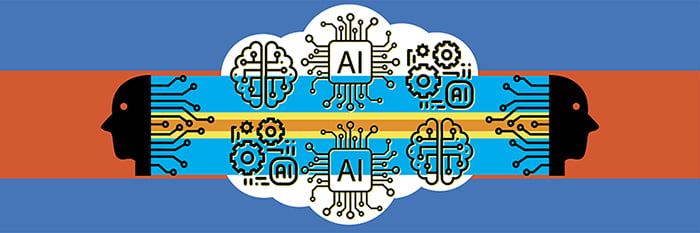
Artificial Intelligence is rapidly changing how businesses approach design, production, and efficiency, and labeling is no exception. What once required multiple rounds of design revisions, manual data entry, and long production timelines can now be streamlined with AI-powered tools.
At SixB Labels, we take a forward-thinking approach to labeling, combining decades of expertise with evolving technology. AI label generation is not about replacing human creativity; it’s about enhancing it, simplifying workflows, and improving accuracy across your labeling program.
What Is AI Label Generation?
AI label generation refers to the use of artificial intelligence to assist in creating, optimizing, and managing labels. This can include:
- Automatically generating label designs

- Suggesting layouts, fonts, and color schemes
- Creating or formatting product data (like ingredients or barcodes)
- Personalizing labels at scale
- Reducing errors in labeling workflows
These tools can dramatically reduce the time it takes to go from concept to production, especially for businesses managing multiple SKUs or product variations.
Example Prompt: "face mask for women's product, need a logo and product packaging using a rose colored theme palette".
Beautiful right? Yet nearly impossible to read or print due to very small type.
Why AI Is Becoming Essential in Labeling
As product lines expand and regulations grow more complex, labeling has become more demanding. AI helps businesses keep up by:
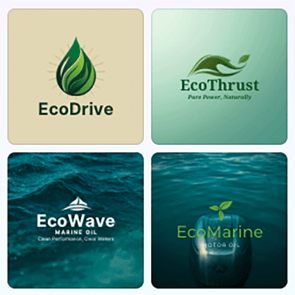 1. Speeding Up Design Processes - AI tools can generate design concepts in seconds, helping brands quickly explore different label styles, layouts, and formats without starting from scratch.
Example Prompt: "thumbnail designs for an eco-friendly boat motor oil logo"
2. Improving Accuracy and Reducing Errors - Manual labeling processes can lead to costly mistakes—incorrect barcodes, missing information, or misprints. AI can validate data, standardize formats, and reduce human error.
3. Enabling Personalization at Scale - From batch numbers to region-specific compliance details, AI allows for dynamic content generation across thousands of labels without slowing down production.
4. Supporting Data-Driven Decisions - AI can analyze performance data and suggest improvements to label design based on customer engagement, readability, or scanning success.
How AI Fits Into The Labeling Workflow
AI doesn’t replace the traditional labeling process, but it enhances each stage:
Design
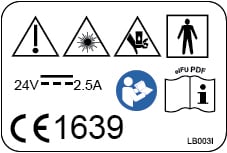
AI-assisted tools can recommend layouts, optimize spacing, and ensure readability, especially for labels that include a mix of branding and compliance information.
 Data Integration
AI can connect with your internal systems (ERP, inventory, or product databases) to automatically populate labels with accurate, up-to-date information.
Proofing and Quality Control
Automated checks can flag inconsistencies or errors before printing, reducing waste and ensuring compliance.
Production
AI can help optimize print runs, material usage, and scheduling—making the entire process more efficient.
Artwork Best Practices When Using AI For Labels
AI can generate impressive visuals, but preparing artwork correctly for print is still critical. Following a few key best practices ensures your AI-generated designs translate into high-quality, production-ready labels:
- Always provide vector files when possible – Formats like .EPS or .TIFF ensure your artwork scales cleanly without losing quality.
- Use high resolution –Resolution of 300 dpi for Grayscale or Duotone is adequate for process modes. Line Art and Spot Color require a minimum of 1200 dpi resolution
- Include proper bleed settings – AI tools often export without bleed by default. Adding bleed before final export prevents unwanted white edges during trimming.
- Choose suitable fonts – Type 1 fonts are among the best practices, as their shapes have more accuracy, providing cleaner printing at smaller point sizes and better font format transferability between Macs and PCs
One key limitation with many AI tools is that you may not be able to easily go back and adjust technical settings like bleed after export, so it’s important to finalize these details before downloading your artwork.


Using AI Tools for Label Design
Not all AI design tools are created equal. As of now, several platforms are showing strong potential for label-related workflows:
- Adobe (Firefly & Creative Cloud tools) – Strong for professional design integration and print-ready output
- Canva – User-friendly with improved export and layout capabilities
- Claude and other generative AI tools – Useful for concept generation, copywriting, and structured label content
AI tools continue to evolve rapidly, but most still require post-processing and refinement to meet professional print standards.
Using AI-Generated Imagery in Labels: Best Practices
What to Do
- Use AI for concept development and early-stage design exploration

- Test multiple variations to find the best visual direction
- Refine artwork for print (resolution, color mode, sharpness)
- Keep designs aligned with your brand identity
- Pair visuals with the right materials and finishes for added impact
What to Avoid
- Don’t use AI output without review—watch for distortions or inconsistencies
- Avoid overly complex designs that won’t scale well on smaller labels
- Don’t ignore compliance space (barcodes, ingredients, warnings)
- Be mindful of originality and usage rights

- Don’t overlook real-world performance (heat, moisture, handling)
AI imagery can accelerate creativity, but the best results come from combining AI efficiency with expert refinement and production knowledge.
Balancing AI with Professional Labeling Software
While AI tools are excellent for generating ideas and visuals, businesses with ongoing or high-volume labeling needs often require more structured solutions.
This is where Loftware Cloud and NiceLabel solutions come in. As a Loftware partner, offering barcode software and training, we help businesses:

- Design labels with a familiar, user-friendly interface
- Integrate labeling directly with business systems (ERP, WMS, etc.)
- Automate printing workflows and reduce manual input
- Manage compliance and standardization across teams
If you’re producing labels regularly, the question isn’t just AI vs software; it’s about using AI for creativity and Loftware for control, scalability, and production efficiency.
Applications Across Industries
AI label generation is already making an impact across a wide range of industries:
- Food & Beverage – Automating nutritional labels and ingredient updates
- Wine & Spirits – Managing vintage, batch, and regional variations
- Cosmetics & Personal Care – Supporting multi-language and compliance-heavy labels
- Industrial & HVAC Equipment – Ensuring accurate safety and identification labels
- Retail & Consumer Goods – Scaling branding across large product lines
No matter the industry, AI helps simplify complexity and improve consistency.
2026 Trends: Where AI Labeling Is Headed
As we looked at in our 2026 label trends blog, AI will continue to shape labeling in several key ways:
- Real-time label updates connected to live data
- Smarter personalization for targeted markets and regions
- Integration with smart packaging (QR codes, digital experiences)
- Predictive design optimization based on user behavior
- Faster, more efficient production cycles
Labels are evolving from static identifiers into dynamic tools for communication and engagement.
How SixB Labels Supports AI-Driven Labeling
 At SixB Labels, we take a 360-degree approach to your labeling program. That means helping you integrate new technologies like AI while maintaining the quality, durability, and precision your products require.
We offer:
- Custom label design and consultation
- Barcode and variable data solutions
- Flexible printing methods and materials
- Integration with in-house printing systems
- Training and support for labeling software and workflows
Our goal is to make your labeling process simpler, smarter, and more efficient, without compromising on performance.
Final Thoughts: Smarter Labels Start Here
AI label generation represents a major shift in how businesses approach labeling. By combining automation with expertise, companies can reduce errors, improve speed, and create labels that are both functional and visually compelling.
With the right tools and the right partner, AI becomes an advantage, not a challenge.
Start simplifying your labeling program with SixB Labels and explore how AI-driven solutions can elevate your labels in 2026 and beyond.
Save Time - Email Us Directly With Your Questions on AI-Generated Labels
See Related: